Can You Use a Massager on Your Knee?
· By Dana Whitfield
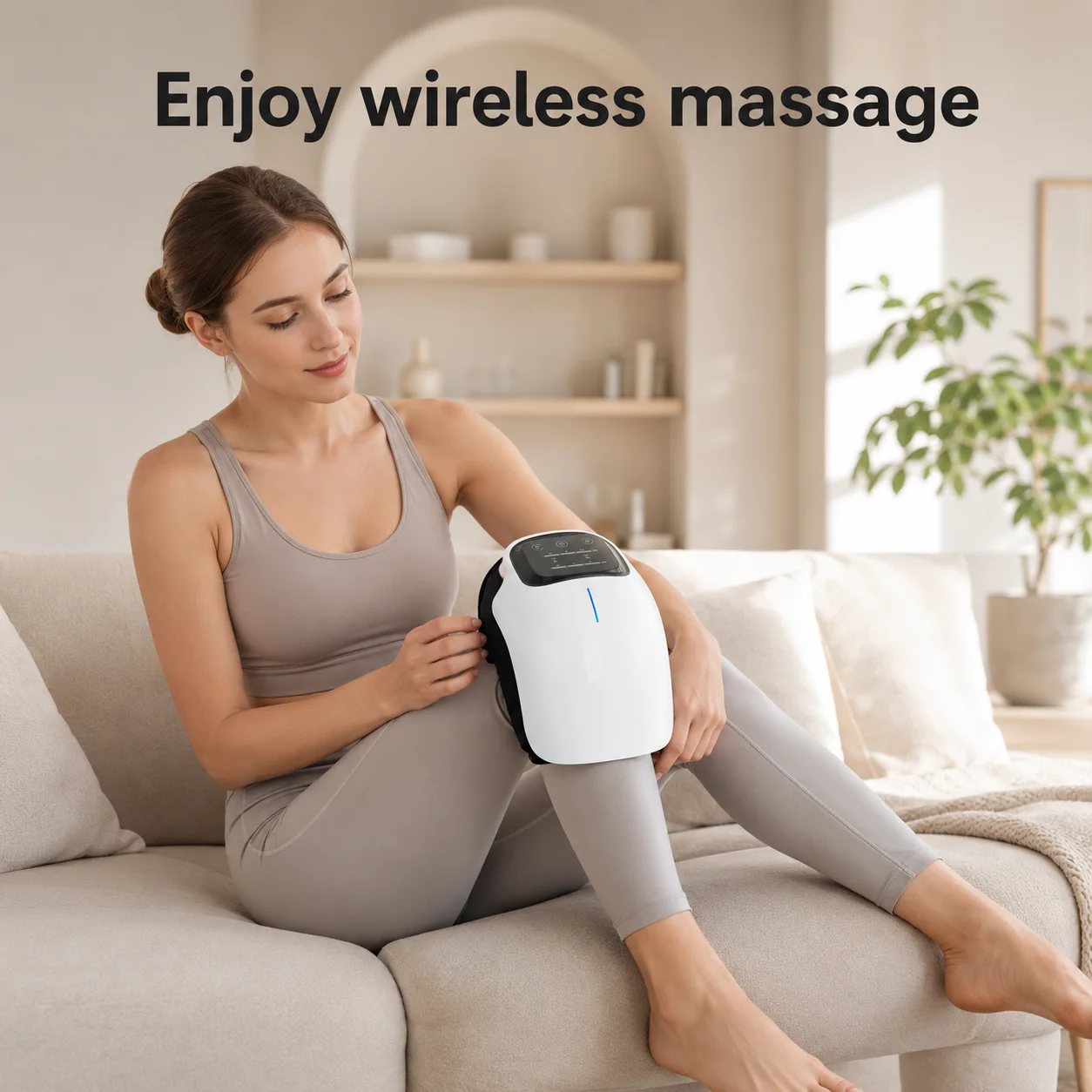
Most people ask because they already own something: a percussion gun bought for a gym routine, a seat cushion for the car, a foot-and-leg unit that came out for one bad week. The knee starts aching, the device is right there, and trying it is the obvious move. What follows is about fit in the literal sense — what each type of device is shaped to touch, and what the knee actually offers it.
Why a Knee Is an Awkward Target for a General Massager
Almost every massage device is built on the same assumption: that the surface it meets is broad, reasonably flat, and padded with a thick layer of muscle. A thigh fits that description. So does a calf, a shoulder, and the long muscles either side of the spine. Pressure spreads across a wide contact patch, and the tissue underneath absorbs it.
A knee offers almost none of that. At the front sits the kneecap, with bone close to the surface and only a thin covering over it. The ridges either side of the joint are bone too. Behind is a soft hollow with structures running through it that nobody should be pressing into. There is no generous muscle belly anywhere on the joint itself, which is the exact thing a general massager is built to work on.
Then there is the part that catches people out: a knee changes shape. Sit down and it is a sharp curve; straighten the leg and it flattens out. Anything resting on it meets a moving surface, so contact that felt even at the start of a session may not be five minutes later.
of US adults have doctor-diagnosed arthritis, one of the most common reasons a general massager gets pointed at a knee in the first place
— CDC/NCHS Data Brief No. 497, Elgaddal et al., 2024
Percussion and Handheld Massagers at the Knee
A percussion device works by driving a head in and out at speed, delivering repeated strokes into whatever it is held against. Over a muscle belly that stroke has somewhere to go: several centimetres of soft tissue take the impact and spread it. Over the front of a knee, the same stroke arrives with very little between the head and bone. The setting has not changed, but what it lands on has, and most people notice the difference immediately.
The second issue is purely practical, and it is the one nobody mentions in a spec sheet. To use a handheld device on your own knee you have to sit folded forward, hold the unit at an angle your wrist does not enjoy, and keep steady pressure on a joint you cannot see well from that position. One hand is occupied for the whole session, and the arm usually gives out well before the knee has had anything.
Kneading handheld units, the ones with rotating nodes you press against yourself, hit the same two walls: they are weighted to be gripped and pushed into a broad surface, and a knee offers neither. If you have a diagnosed knee condition or a recent injury, that is a conversation for your doctor before it is a question about equipment, and our guide on how to use a knee massager safely covers the situations worth raising.
Cushions, Seat Pads and Foot-and-Leg Units
Seat and back cushions are a different design problem with the same outcome. They are engineered to press nodes into a broad, roughly flat plane, held there by your own body weight against a chair. Rest a knee on one and geometry does the rest: the highest point of the joint touches, everything either side of it does not, and the massage concentrates on a patch the size of a coin while the rest of the cushion works against air.
Foot-and-leg units are shaped as a sleeve, sized for the shaft of a calf or the box of a foot. The knee is the widest part of the leg in that stretch, wider than the limb immediately above and below it. Slide a straight sleeve over it and one of two things happens. Either it is cut loose enough to pass over the joint, so it gaps and the pressure never reaches, or it is snug enough to make contact and grips hardest at the widest point rather than around it.
Full-body and chair-style units are built to the shape of a back. There is nothing wrong with any of these designs; they simply answer a different question, and the answer is decided by shape before anyone touches a control panel.
What a General Massager Is Designed Around
It helps to look at the design brief rather than the marketing. Head sizes, node spacing, airbag pressure and stroke depth are all chosen for one target: muscle. Judged on that target, these devices do what they were made to do.
A knee is not a muscle belly. When people say their knee aches they are almost always talking about the joint and the tissue immediately around it, not the quadriceps above or the calf below. That is the gap. A device that only makes even contact with broad muscle will never sit evenly on a joint, and coverage is not a setting you can turn up — it is decided by the shape of the thing touching you.
This is why a separate category exists. A knee massager is not a general massager with a knee label on the box; it is a different shell, built to a different contact surface.
What Changes When the Shell Is Shaped for a Knee
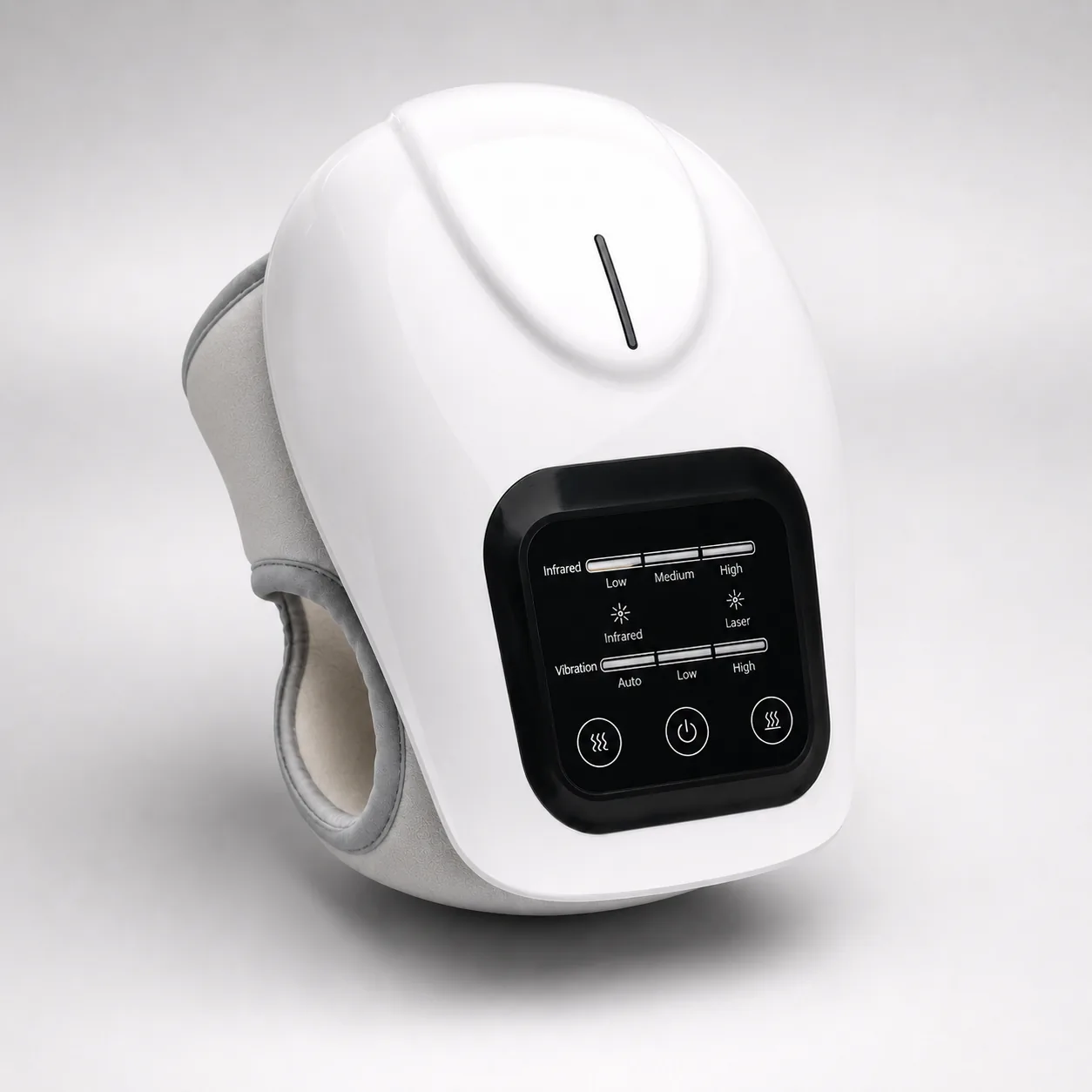
The GlowKnee wrap starts from the opposite end of the problem. The shell is formed into a curved cup with an opening the knee sits inside, so the contact surface follows the joint instead of pressing a flat plane against a curve. The joint is met on the front and both sides at once, which is the coverage a flat device cannot produce no matter how it is positioned.
That shape changes what each function can do. The heat function warms the wrap from the inside, so the joint gets steady warmth on multiple sides rather than one hot spot where a flat pad happens to touch; there is more on our heated knee massager page. The LED red and infrared light sits inside the shell facing the knee directly, which only works if the source is held at a fixed distance and angle throughout. Three vibration levels run from a touchscreen panel on the shell, so a gentler setting is there for sensitive days.
None of that makes it a medical device. It is comfort equipment: warmth, gentle vibration and light aimed at short-term comfort and relaxation around a stiff or achy joint. What the shape buys is contact — the thing a general massager cannot get on a knee.
Why Hands-Free Matters More on This Joint
Hands-free sounds like a convenience feature until you try the alternative on a knee. Holding any device against your own bent knee means one hand out of action, a forward-folded posture, and constant small corrections as the angle drifts. It is why handheld units aimed at the knee tend to get used for two minutes rather than a full sitting.
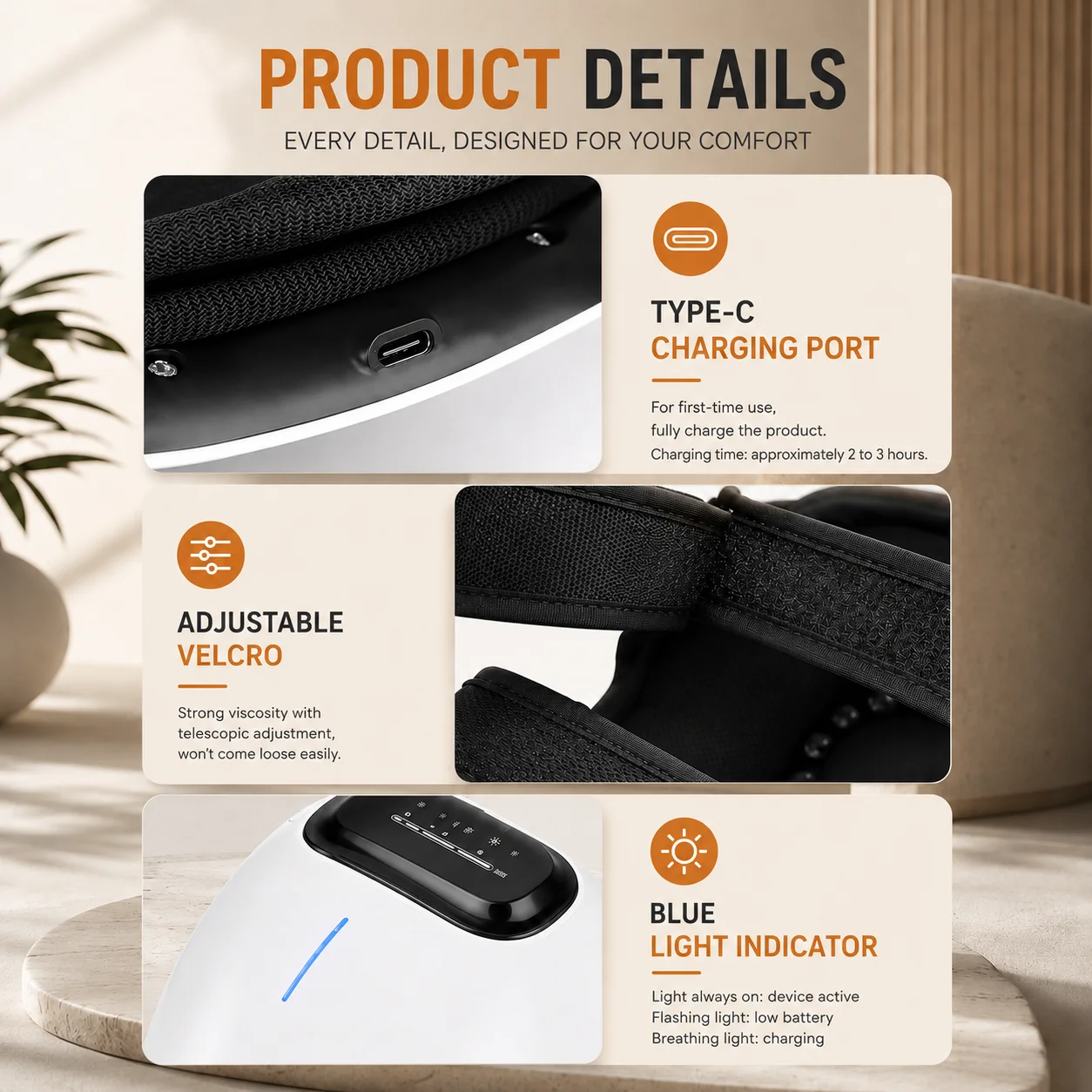
Adjustable velcro straps do the holding instead. Once fastened, the wrap stays where you put it, which matters for more than comfort: a device that slides moves the heat and the light off the area they were aimed at. It runs on its own rechargeable battery, so nothing tethers you to an outlet either — the trade-offs against a plug-in design are set out in our guide to cordless vs. corded knee massagers. Buyers describe how that plays out in our verified reviews, currently 4.7 out of 5 from 74 buyers.
Points That Apply Whichever Device You Use
Shape decides fit, but a few precautions apply to anything that puts heat, pressure or vibration on a knee.
- Keep heat sessions to a sensible length rather than leaving something running for hours. Extended, continuous heat contact is what raises the risk of skin irritation.
- Start on the lowest heat and intensity setting and work up across the first few sessions, rather than starting at the top.
- Check your skin afterwards. Mild pinkness that fades quickly is a normal response to heat; lingering redness, itching or blistering means stopping and checking with a doctor.
- Keep any device off broken skin, a rash, an active skin infection, or a fresh injury that is still swollen.
- Do not rely on how it feels if the skin around the joint is numb or patchy, because the warning that normally tells you something is too warm is missing.
- Talk to a doctor first if you have diabetes, a circulatory condition, an implanted electronic medical device, reduced sensation in the leg, or if you are pregnant.
typical maximum length recommended for a single superficial heat therapy session in physical medicine guidance
— American Academy of Physical Medicine & Rehabilitation, PM&R KnowledgeNow, 2024
Two situations sit outside all of this. If you are managing long-term joint pain, our guide on a knee massager for arthritis covers how a comfort device fits alongside doctor-guided care. If the knee has been operated on, the answer comes from your surgeon and nobody else — the subject of our guide on using a knee massager after knee replacement.
Questions People Ask About Using a Massager on the Knee
Can I use a percussion massager directly on my kneecap?
That class of device drives repeated strokes into muscle tissue, and at the front of the knee there is very little tissue between the head and bone. The stroke that feels fine on a thigh tends to feel sharp over the kneecap. If you have a diagnosed knee condition, put the question to your doctor rather than to a product page.
Will a foot-and-leg massager reach the knee joint?
Usually only in passing. Those units are sized as a sleeve for a calf or a foot, and the knee is wider than the leg above and below it. A straight sleeve either gaps at the joint or grips hardest at its widest point, so the massage lands where the shape happens to touch.
Can I use a back or seat massage cushion on my knee?
You can rest a knee against one, but a seat cushion is engineered to press nodes into a broad, roughly flat plane. A knee is a curve. Contact ends up limited to the highest point of the joint, and the rest of the cushion works against nothing.
What about a general massager on the muscles above and below the knee?
That is the surface those devices are designed around: a broad muscle belly with a thick layer of tissue over the bone. It is a different target from the joint itself, which is the part people usually mean when they say their knee aches.
Can I use one wrap on both knees in the same session?
The GlowKnee wrap is built to fasten around one knee at a time, so a session covers one joint and then the other. If both knees are part of your routine, the two-pack listed on the product page covers them at once.

Dana Whitfield · Wellness Product Tester at GlowKnee
Dana has tested dozens of at-home recovery and wellness devices for GlowKnee and writes the guides on this site. She is not a doctor or a physical therapist, and nothing here is medical advice.
Comfort and relaxation claims only. See how we test.